
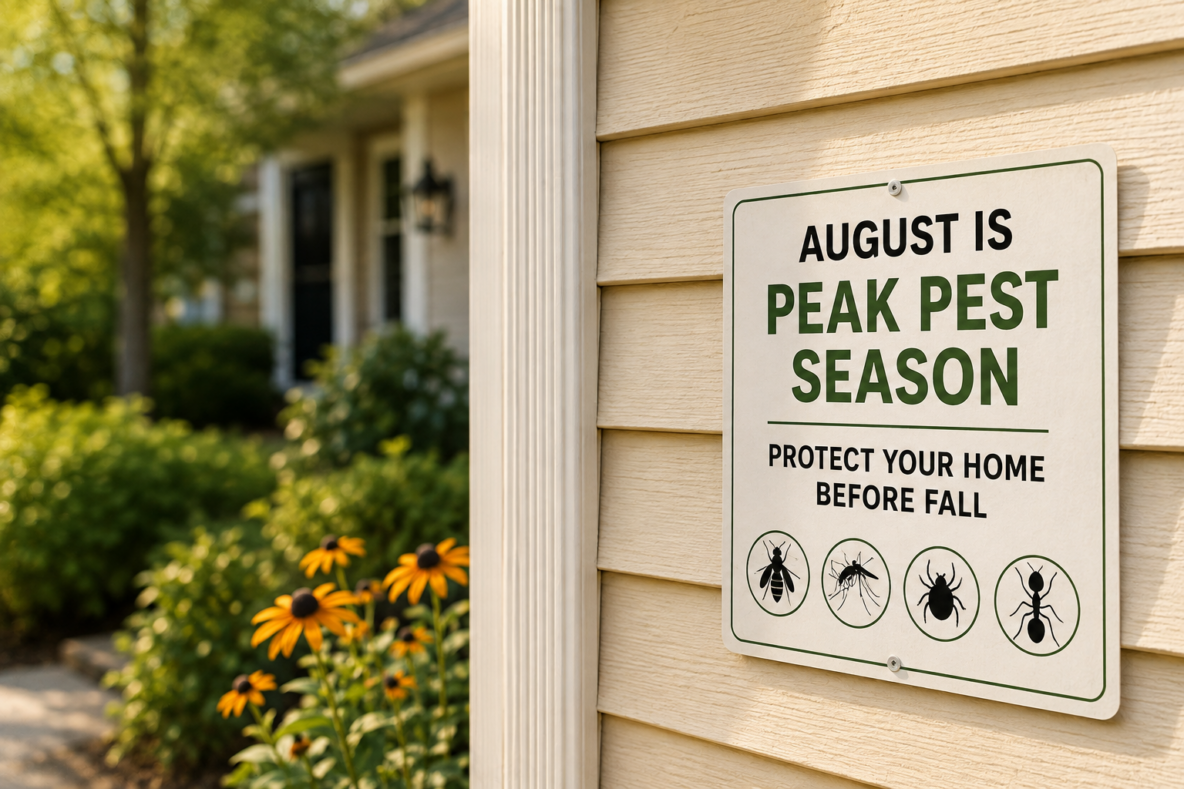
Late Summer Pest Guide for Homeowners in York County, PA & Northern Maryland
When most people think about pest season, they picture spring.
The truth is, August is one of the busiest months of the entire year for pest activity.
If you’ve noticed more wasps buzzing around your deck, mosquitoes ruining evenings outside, spiders appearing in the corners of your home, or ants suddenly marching through your kitchen, you’re not imagining things.
Late summer is when many pests reach their peak populations, and when they begin preparing for the cooler months ahead.
Understanding why this happens can help you stop an infestation before it becomes a much bigger problem.
Why August Is Peak Pest Season
Throughout the summer, insects have been quietly building colonies, reproducing, and expanding their territory.
By August, many species are at their largest population of the year.
They’re actively searching for:
- Food
- Water
- Shelter
- Places to overwinter
- New nesting locations
That’s why homeowners often notice what feels like a sudden explosion of pest activity, even if they haven’t had problems earlier in the season.
Let’s look at the biggest culprits.
Yellow Jackets Become More Aggressive
If you’ve ever felt like yellow jackets become angrier in late summer…
You’re right.
By August:
- Colonies can contain thousands of workers.
- Natural food sources begin disappearing.
- Worker yellow jackets start searching for sugary foods and proteins.
- They aggressively defend their nests.
That’s why you’ll suddenly notice them around:
 Backyard cookouts
 Soda cans
 Garbage cans
 Fruit trees
 Pet food bowls
Unlike honey bees, yellow jackets can sting repeatedly and often attack in groups when they feel threatened.
If you notice heavy activity around your deck, shed, wall, or underground burrow, don’t wait. Small nests grow quickly this time of year.
Carpenter Bees Don’t Leave, They Come Back
One of the biggest misconceptions homeowners have is that carpenter bees disappear after spring.
They don’t.
The adults remain active through much of the summer, and the tunnels they create stay behind year after year.
Every season those same holes become more attractive to future carpenter bees.
Over time this can lead to:
- Damaged deck rails
- Fascia board deterioration
- Porch ceiling damage
- Pergolas and fences weakening
- Woodpecker damage as birds search for larvae
One carpenter bee isn’t usually the problem.
The damage comes from repeated nesting in the same wood.
That’s why we treat the wood—not just the bee.
Mosquitoes Don’t Need a Pond
Here’s one of the biggest surprises for homeowners:
Mosquitoes don’t need a lake.
They don’t even need a puddle.
Many species can breed in about a bottlecap of standing water in roughly one week.
Common breeding sites include:
- Clogged gutters
- Children’s toys
- Bird baths
- Plant saucers
- Buckets
- Wheelbarrows
- Pool covers
- Tarps
- Pet bowls
Instead of simply fogging a yard before a party, identifying and treating breeding areas provides much longer-lasting mosquito control.
Ticks Follow Wildlife
Most people imagine ticks crawling across their lawn waiting for someone to walk by.
That’s not how they operate.
Ticks wait where animals travel.
Common high-risk areas include:
- Wooded property edges
- Tall grass
- Fence lines
- Brush piles
- Leaf litter
- Wildlife trails
While deer are one of the biggest ways ticks are introduced to a property, they’re not the only carriers.
Ticks also hitch rides on:
- Dogs
- Rabbits
- Raccoons
- Foxes
- Squirrels
- Outdoor cats
That’s why targeted perimeter treatments are often far more effective than spraying an entire lawn.
More Spiders Usually Mean More Bugs
Here’s something many homeowners don’t realize:
Spiders aren’t invading your home.
They’re following dinner.
If insect activity increases, spider populations usually increase too.
Seeing more spiders often means there’s another insect population nearby providing an easy food source.
Reducing those insects often reduces spider activity as well.
Ant Colonies Are At Their Largest
By August, ant colonies have been growing all season.
Workers are busy collecting food before cooler weather arrives.
That’s why homeowners suddenly notice ants around:
- Kitchens
- Pantries
- Garbage areas
- Pet food
- Outdoor patios
Treating visible ants without eliminating the colony rarely solves the problem long-term.
It’s Time To Think About Fall Pests
Believe it or not, some pests are already preparing for cooler weather.
Late August is when we begin seeing:
Stink Bugs
Searching for warm places to spend the winter.
Boxelder Bugs
Gathering on sunny walls.
Mice
Exploring homes before temperatures drop.
Finding and sealing entry points now can prevent much larger problems later in the fall.
Your August Pest Prevention Checklist
Before summer ends, take a few minutes to inspect your property.
 Empty standing water
Clean clogged gutters
Trim tall grass and vegetation
Remove brush piles
Seal cracks around doors and windows
Inspect decks for carpenter bee holes
Watch for yellow jacket activity
Look for signs of rodents
Schedule a preventative perimeter treatment
A little prevention now can save significant repairs, and frustration, later.
Why Choose EcoPest + The Bee Guys?
We’re proud to serve homeowners and businesses throughout York County, Pennsylvania, and Northern Maryland with honest, effective pest management solutions.
Our services include:
- Residential Pest Control
- Commercial Pest Control
- Honey Bee Removal & Relocation
- Carpenter Bee Treatment
- Yellow Jacket & Hornet Removal
- Mosquito Control
- Tick Control
- Spider Control
- Ant Control
- Rodent Control
- Emergency Pest Services
PA & Maryland Certified
Family-Owned
Guaranteed Services
Frequently Asked Questions
Why are yellow jackets more aggressive in August?
By late summer, yellow jacket colonies are at their largest. Natural food sources begin disappearing, causing workers to aggressively search for sugary foods and defend their nests.
Do carpenter bees come back every year?
Yes. Carpenter bees often return to the same wooden structures each year if the tunnels aren’t properly treated and sealed.
Why are mosquitoes worse after it rains?
Standing water left behind after rain creates ideal breeding sites. Mosquitoes can develop from egg to adult in about a week under the right conditions.
Where are ticks usually found?
Ticks are most commonly found along wooded edges, tall grass, brush, leaf litter, fence lines, and wildlife travel corridors, not in the middle of open lawns.
Why am I seeing more spiders all of a sudden?
Spiders usually increase where insect populations are high. If you’re seeing more spiders, they may be feeding on another pest problem nearby.
Should I wait until I have a pest problem before calling?
Preventative treatments are almost always more effective, and less expensive, than waiting until an infestation becomes established.
Protect Your Home Before Summer Turns Into Fall
Late summer is when small pest problems often become major infestations.
Whether you’re dealing with aggressive yellow jackets, carpenter bees damaging your deck, mosquitoes ruining evenings outside, or ticks hiding along your property line, taking action now can save you time, money, and headaches later.
Call or text EcoPest + The Bee Guys today for a free estimate.
 717-693-5522
- Penn State Extension (carpenter bees, ticks, mosquitoes, spotted lanternfly)
- University of Maryland Extension (regional pest guidance)
- CDC (tick prevention and Lyme disease)
- EPA (mosquito prevention)
- National Pest Management Association (NPMA)